
Imaginary Worlds

S came home from school yesterday with a poster-sized paper scroll that he wanted to show me the second he got in the door. It’s my imaginary world, he said, and I felt myself wilt.
The poster paper, once unscrolled, showed a magenta landscape in the middle of which floated a scanned image that I recognized as one of S’s self-portraits. Both S and T spend a lot of time drawing and re-drawing the same set of images. For S it’s himself, himself as a baby, dinosaurs, dinosaurs as babies, and, for better or worse, dinosaurs in the middle of pooping. The line drawing in the middle of the page he held shows a smiling face, a square body, and foreshortened hands and arms that read to me as angel wings. These are recognizable characteristics of his recent self-portraits. Behind this familiar and beloved image is a chaotic proliferation of AI-generated visuals clearly based on a prompt including many of my son’s favourite things. There are dinosaurs, racecars, spaceships, candy shops, tall fruit-bearing trees, and an uncorralled crowd of sentient rubber duckies. Everything aside from the trees is drawn in some shade of pink, which has long been his favourite colour.
This is the second time my kids have come home with something AI-generated in the last few months. Earlier this term, T came home with a colouring page made from a photo taken at a recent field trip. There we are in cartoonish outline, S and T and I with our arms around each other, crouched in the midst of T’s classmates and their mothers and the class’s lovely teachers. I think a parent made this one, without having asked us for permission to feed our or our children’s likenesses into an AI image generator.
I’m not really that rigid about online privacy for myself. I know that my information is out there to such an extent that trying to reel it back in would be pointless. As an adult who has grown with the proliferation of social media, I feel comfortable with that. I think my critical thinking skills are adequate to the task of facing down the kind of curated advertising that is constantly sent my way. Not that I think I’m immune to advertising, just that I have strategies and guardrails in place. My image is also something I feel no sense of propriety over. It’s not as important to me as other things. My children’s images, though - those are theirs, and they are too young to be able to decide what to do with them. We don’t post our kids’ faces on social media very often for this reason.
The AI-generated imaginary world that S brought home feels to me like a failure. It’s not a failure of my son’s imagination, but of adult willingness to exercise and allow imagination. It is an unnecessary augmentation of my son’s wild and vivid inner world, and the renderings of it that he has started to make. My kids get to do lots of creative things at school, but seeing this bizarre computation of my child’s obsessions and interests into something so blandly stylized, so overly polished - something he can’t easily imitate and which might frustrate his expectations of what he himself is able to make and which risks narrowing his aesthetic sense - makes me worry about what will come next. Which technologies are entering their classrooms when they aren’t even five years old yet? Will they spend the tenderest years of their childhood learning that something non-sentient can imagine a better imaginary world than what they can make up for themselves?
I don’t want to come off as rigidly anti-AI. There are good use cases for these new technologies, and I know that there are artists who use AI thoughtfully as part of their artistic practice. Broadly speaking, though, replacing human creativity and imagination make for poor use cases for AI. Last week, translations of a speech delivered by Polish Nobel laureate Olga Tokarczuk bubbled across the literary internet after she made comments indicating that she has engaged AI in her creative process. The more devastating comments to me, though, and to many of my friends, were those that indicated that she believes that human-created literature is a dying form; that the novelist siloed in her imaginative, creative, deeply thoughtful act for long durations is soon to disappear.
I’ve been reading Vauhini Vara’s book Searches: Selfhood in the Digital Age. She comes from a journalism background, and she interviewed Sam Altman in OpenAI’s early days. At that time, he seemed to have at least a partial commitment to finding the best use cases for AI. He talked about working toward a world in which humans would be freer to make meaningful lives; to spend time together and to engage our creativity. Clearly, AI’s usage is not being focused in this way. When I think about what makes AI ‘art’ bad, it isn’t the aesthetics or the (rapidly declining) incoherence. It’s the fact that the images and text produced by AI don’t let me at any particular kind of experience. They don’t come from a person. Reading novels and poems and essays is vital to me because of the connections those art forms create between other people and myself and unreachable nuances of our world. I’m not interested in reading things that were algorithmically generated, even if they are aesthetically interesting in some way. I want human mess and error.
I’ve read Tokarczuk’s work. Fortunately, her most popular novel, Drive Your Plow Over the Bones of the Dead, was written before it would have been possible for her to use AI in her creative process. It’s an incredible book with a wildly contradictory narrator with whom I fell in love by the end of her story. Tokarczuk later walked back part of her statement, but did not amend her comment about the kind of writing process she went through to write this book becoming a thing of the past. Although it is clear that AI is here to stay, and it will probably insinuate itself much more deeply in our lives before it becomes better regulated, I have to believe that this kind of creative work will continue to come into being at human hands. I’m working on this kind of writing myself. It has never been and never will be lucrative, but that’s not the point of doing it. My kids will probably have to learn how to use AI tools in their workplaces when they’re adults. That’s different from stealing these years of their most unselfconscious creativity out from under them. Bringing these kinds of technologies to our kids at such early ages feels to me like it risks foreclosing on their imaginations, like it threatens emergent artists and writers who would otherwise be piecing their internal words together out of stories and new words and transient things they draw in the sand.
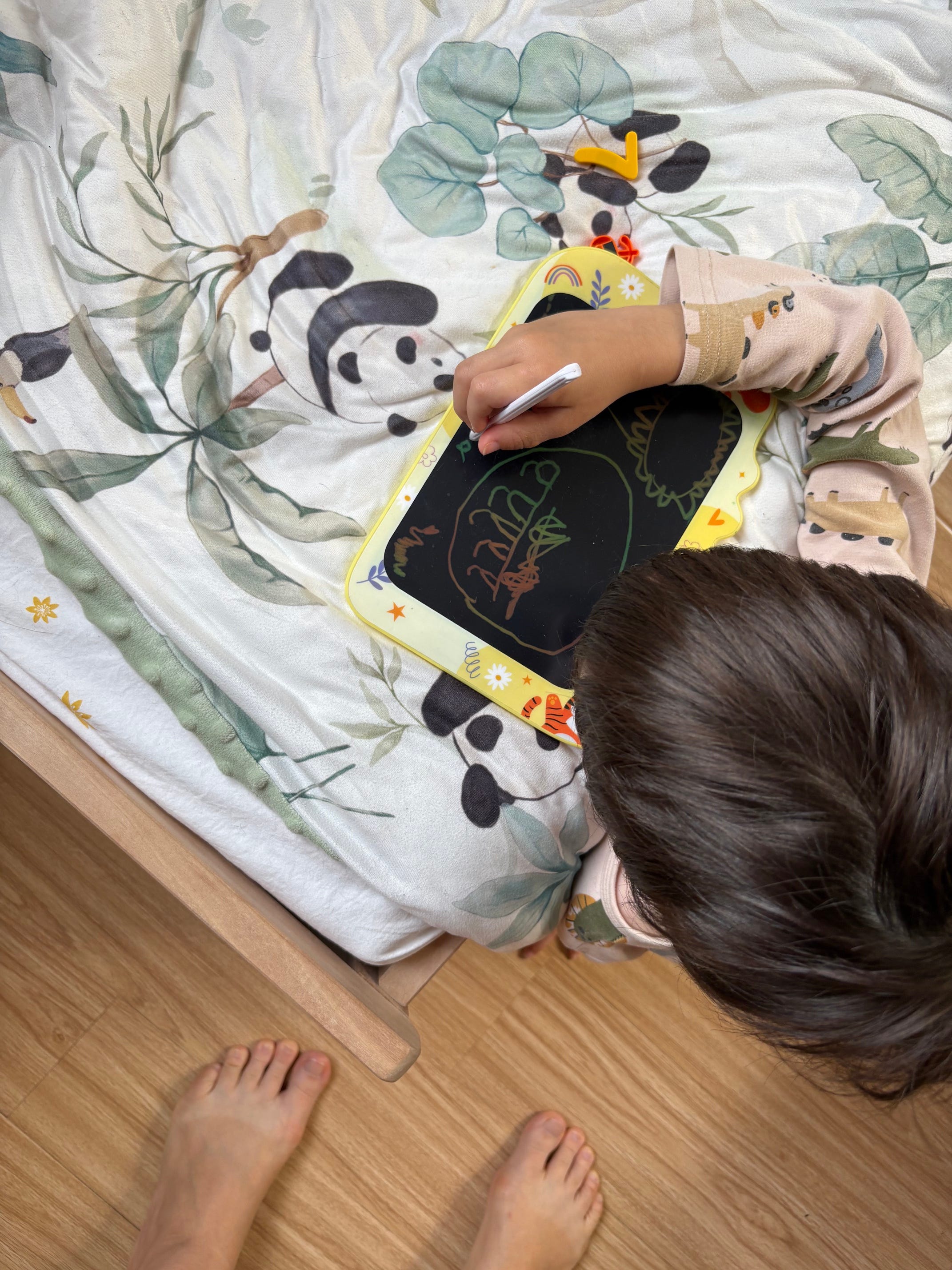
At home, we keep the drawing materials in easy reach. The kids have drawing boards that can be erased and reused over and over again. S carries his with him on the school bus and likes to bring it when we go to the playground, even if he isn’t going to use it. This feels akin to my own need to carry a notebook everywhere I go, to bring at least two books so that I have options if I have an opportunity to read, even when I know it’s unlikely that my day will allow for it. T learns new dance moves from the women at the parks; she brings home a playdough panda bear as a gift for me. The two of them use blankets and cushions to build a giant monster in their room and run through the house pretending to be baby monsters. They love eating loquats fresh from the neighbourhood trees. Since the one in our complex is too tall for us to reach, I gave in to my baser urges and ordered a telescoping fruit picking device. The last two evenings, after dinner, we’ve brought our new picker out to the heavily fruiting tree. I reach up into it and pull down a miniature harvest while bats skitter above us in the twilight. Back at the table, we peel the washed fruit and eat their tender flesh. When the kids go to bed at night, they bring their drawing boards with them.